
- See All
- Infrastructure & Project Finance
- Mergers & Acquisitions
- Banking & Finance
- Real Estate
- Energy & Natural Resources
- Global Trade & Customs
- Intellectual Property
- Employment & Labor
- Wealth Management
- Capital Markets
- Competition & Anti-Trust
- Data Protection
- Corporate Support
- White Collar Crime & Investigations
- Dispute Resolution

In joint stock companies, representation is vested in the board of directors. However, as companies grow and expand, it often becomes necessary to adapt or diversify the way representation is structured. To address this need, the Turkish Commercial Code numbered 6102 (“TCC”) [i] allows boards of directors to delegate representation authority, provided that at least one member retains unlimited representation powers.
Delegation is possible if the company’s articles of association permit it, and it requires the preparation of internal directives as well as clear allocation of authority. These steps must be registered with the trade registry and published in the Turkish Trade Registry Gazette, in line with both legislation and the practical guidelines published by the relevant trade registry offices.
Because registry practices may differ, this article focuses on the approach of the Istanbul Trade Registry, covering the determination of signatories, the electronic application process via the Central Registry System (“MERSIS”), and key lessons learned in practice.
Election of Board Members and Designation of Unlimited Signatories
The general assembly elects board members. Some practical points to consider during these meetings are as follows:
- Details to Include in General Assembly Minutes: The resolution regarding the election of board members must be recorded in the general assembly minutes, specifying the number of board members, their identity information (Turkish ID number or foreign ID/potential tax number), and their addresses. (Additional requirements apply for appointing a legal entity to the board.)
- Appointing at Least One Unlimited Signatory from the Board: Following the general assembly meeting at which the members of the board of directors are appointed, the board must adopt a resolution appointing at least one member as an unlimited signatory. Otherwise, it is not possible to proceed with the electronic application through the MERSIS system.
- Duty Acceptance Declaration and Signature Declarations: After the general assembly meeting where board members are determined, a duty acceptance declaration and notarized signature declaration must be submitted for board members when applying to the trade registry. For automation, “Authorization Acceptance Process” module was introduced in MERSIS. To this end, the requirements for the following persons are different and can be summarized as follows:
| Appointees who are; | Duty Acceptance Declaration | Notarized Signature Declaration |
| (i) Turkish citizens with the new ID card (and therefore have previously provided their signature samples and have access to the e-Government system), | – (to be performed over MERSIS) | _ |
| Turkish citizens who do not have the new ID card but have access to the e-Government system | – (to be performed over MERSIS) | ✔ |
| Foreigners who do not have access to the e-Government system or provided a signature sample | ✔ | ✔ |
Internal Directive And Authorized Signature Authorities
What Should be Considered When Preparing an Internal Directive?
Under Article 371/7 of the TCC, representation powers can be delegated through an internal directive, approved by the board, registered and published. Internal directives are frequently used as a general management tool in companies with a large number of executives and managers to enable the company to conduct its business. Trade registries have different practices with regard to the content of the internal directive, and it would be useful to review the relevant registry’s sources while drafting the relevant documentation (e.g., Istanbul Chamber of Commerce’s informative text dated 31 March 2023).
For instance, the Istanbul Trade Registry requires that internal directives:
- Define the scope (authority levels/signature groups) and limits of limited representation authority, with the procedures and principles governing the exercise of such authority (individually/jointly). Although this is the rule, in practice, the Istanbul Trade Registry permits inclusion of unlimited authority in the internal directive if the internal directive expressly grants a signature group/title with unlimited representation authority. In this case, the unlimited representation authority should be clearly explained in the text as “unlimited representation authority in the broadest sense—in all matters” and that the group/level/position to which this authority is granted should be clearly defined.
- Be dated and numbered, with no names of appointees included.
- Be signed on every page by the board members who signed the decision to approve the internal directive.
- Be replaced, registered, and published in full with a different date and number if amended, rather than being updated partially.
In practice, it is advisable to consult with public and private institutions, such as certain governmental agencies or banks with which the company frequently interacts, to ensure the wording of internal directives (or their relevant parts) is acceptable to them.
What Should Be Considered While Preparing the Board of Directors’ Decision Determining Limited Signatory Authorities?
Signatories who are authorized according to the internal directive must be appointed by a separate board resolution, specifying which internal directive the authorization is based on.
Until recently, the company’s internal directive had to be registered and announced first, and then appointments had to be made according to this internal directive through a separate application. As of 16 May 2025, MERSIS and trade registries allow companies to submit both resolutions regarding (i) the adoption of the company’s internal directive and (ii) the appointment of signatories in accordance with these directives in a single application.
Based on our experience in various registries, key points to observe are as follows:
- The board resolution regarding the appointment must include the name, surname, nationality, identity number, place of residence, and signature group or signature level (as defined/mentioned in the internal directive) to which the persons are to be appointed.
- Board members appointed as limited signatories are only authorized for the duration of their board membership, which should be mentioned in the resolution.
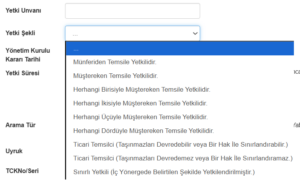
- A person cannot simultaneously hold both unlimited and limited representation authority. While entering the appointments in MERSIS, the options other than “Limited Authorized (Authorized as specified in the Internal Directive) (Sınırlı Yetkili (İç Yönergede Belirtilen Şekilde Yetkilendirilmiştir))” as “the type of authority” should not be selected if the “Authority Title (Yetki Unvanı)” section will be filled with a signature group defined under the internal directive:
The following table summarizes the key rules and exceptions regarding the assignment of unlimited and limited representation authority within joint-stock companies:
| Table: Rules on Unlimited and Limited Representation Authority | |
| Rule | Exception / Practical Note |
| A person cannot simultaneously hold both unlimited and limited representation authority. | If an unlimited authorized signature group is expressly defined in the internal directive, this constitutes an exception. |
| A person appointed as unlimited representative with his/her individual signature cannot also be appointed as a limited representative (individually or jointly) for specific matters. | — |
| A person appointed as a joint unlimited representative cannot also be appointed as a limited individual representative. | — |
| A person appointed as a joint unlimited representative cannot also be appointed as a limited joint representative with the same persons with whom they share unlimited authority. | However, the internal directive may stipulate that a limited authority must be exercised jointly with a joint unlimited representative. In this case, the unlimited authority is not restricted; instead, the limited authority is conditioned upon the involvement of the unlimited representative. |
| A person cannot be assigned to more than one signature group/level/title defined in the internal directive. | However, the internal directive may stipulate that the signature groups above can exercise the authorities of below group/groups. |
| The appointment resolution should only refer to the date and number of the internal directive; details of the authorities should not be restated in the resolution. | — |
| A person cannot be appointed to a title that is not defined in the internal directive. | Example: If only Groups A, B, and C are defined, a person can be appointed as a “Group B Signatory,” but not as “Finance Manager (Group B Signatory).”
Although this title may be granted in the scope of company’s internal operations, such an appointment cannot be registered in the trade registry and made public via announcement in the Trade Registry Gazette (and be applicable to the third parties). |
| As per the recent updates on MERSIS, when a new internal directive is adopted, the resolution for appointment of signatories as per the new internal directive must explicitly state whether the existing authorities continue without change or whether powers/titles are changed. | – If unchanged: resolution should state that previous authorities continue without modification. – If changed: resolution should expressly state the modifications. |
Electronic Application Over MERSIS
Once documents regarding the company’s signatories are ready, the electronic application must be completed through MERSIS.
As of 14 April 2025, individuals who have access to the e-Government (e-Devlet) system (i.e., Turkish citizens and foreigners with a foreigner identity number provided by Turkish authorities) are only able to log in to MERSIS via the e-Government portal, or using an e-signature / mobile signature method, to ensure more effective verification and security in MERSIS.
When entering appointments via MERSIS:
- As board members can only be appointed for a limited period of time, the end date of their term or position must also be added to the system.
- Signatory titles must match those in the internal directives and board resolution, and the appointed signatories must perform authorization acceptance in MERSIS (as explained above).
Conclusion
Procedures related to the representation of joint-stock companies are not merely a matter of fulfilling formal requirements; they are critical and directly affect the company’s operations and the security of commercial life. In practice, even minor deficiencies in the document set drafted for the election of board members, appointment of signatories, preparation of internal directives, and processes conducted through MERSIS can lead to rejection of applications by the trade registry. Consequently, companies suffer losses of both time and effort, as well as transaction costs.
Key takeaways for companies include:
- General assembly and board of directors’ resolutions must fully comply with the details stipulated in the law and relevant trade registry practices.
- Internal directives must be prepared in line with the needs of the company and the practices of the relevant trade registries.
- Signing authorities must be assigned in a manner that does not create conflicts of authority.
- Actions to be conducted through MERSIS must be carefully monitored, and the authorization acceptance process must be completed correctly.
- Considering that there may be differences in practice from one registry to another, the relevant registry’s requirements must be confirmed before submitting the application.
Ultimately, well-structured representation provides both managerial flexibility and legal security. Therefore, it is of great importance to regularly follow current trade registry announcements, prepare all necessary documents before the application, and seek expert advice in case of doubt.
[i] Published in the Official Gazette dated 14 February 2011 and numbered 27846.